
#59.5 | "Fame or fortune?" [FICTION]
Professor Ilya Kovačević ~ Invention ~ Marie Ryndel ~ Fame or fortune?

Note: The following is a work of fiction and not necessarily representative of my own personal views. On January 8, I committed to writing a serialized fiction novel, 500-words-a-day for the next thirty days. Every day, I sit down and write 500 divinely inspired words as the story unfolds in my head. Please don’t send me angry DMs or comments; I’m just a conduit for the Universe! Enjoy!! 🎉
V. Professor Ilya Kovačević
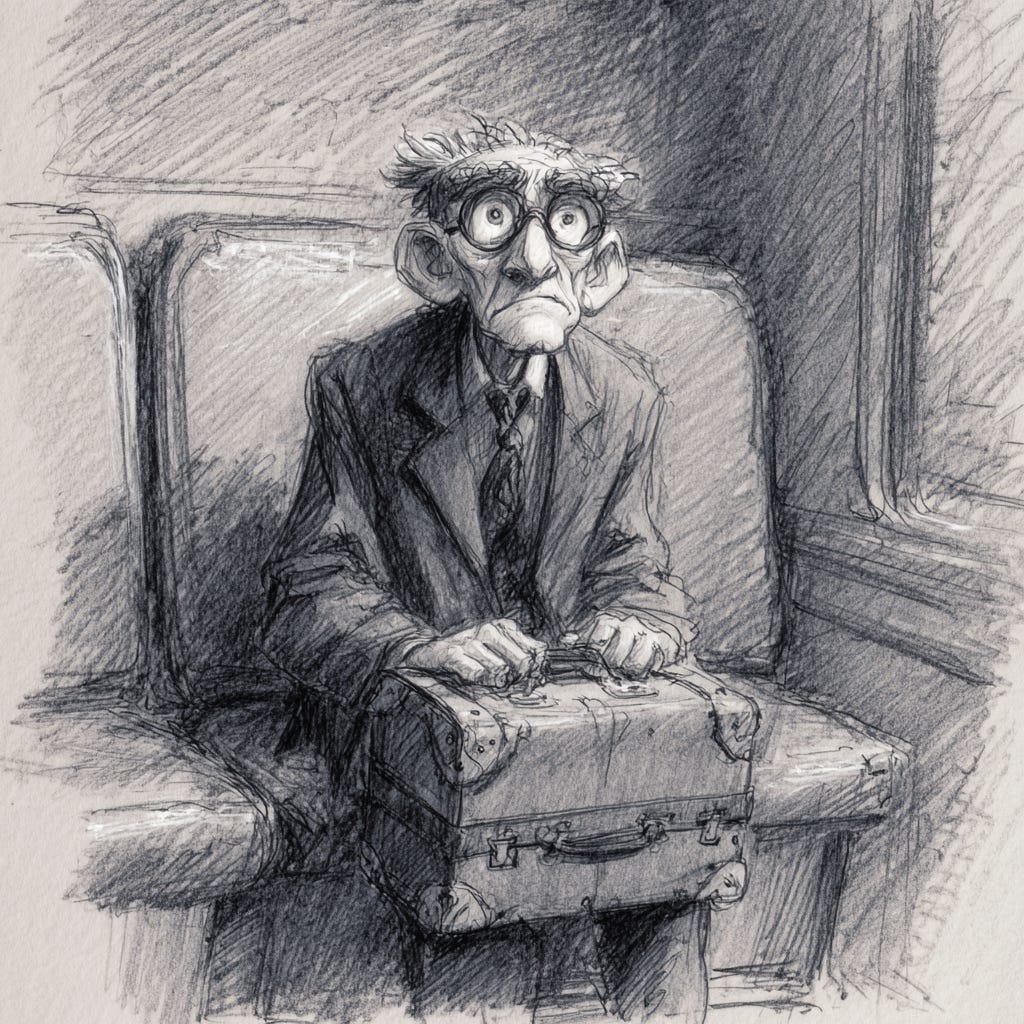
Elsewhere at that very moment on that very train which Martin disembarks, Dr. Ilya Kovačević, distinguished professor emiritus of the Sorbonne, climbs aboard a few cars up and makes his way to up front. In his arms, he tightly clutches a tattered brown leather suitcase. En route to Zurich, he’ll in two days time give a technical demonstration of his device to a secretive cabal of investors who’ll proceed to give him millions for his invention. A slight, bespectacled man with hunched shoulders, Ilya has the look of a turtle who is permanently startled. His companion, Marie Ryndel, is already in the forward cabin waiting for him when he sits. Ilya does not yet know it but this invention in his suitcase will in three days time be the lynchpin on which all of human history will turn.
“Good seeing you again, Professor,” Marie says as he sits down opposite her. “I trust you found your travels here satisfactory?”
“Very much so,” stutters Ilya. He is always tongue tied when he finds himself around beautiful women. It’s one reason he’s a professor and not another profession.
“Everyone’s very excited to see what you’ll be showing,” says Marie smiling. “It’s been long promised, but no one’s ever been able to demonstrate one that works.”
“It is my life’s work,” says Ilya. “The culmination of everything I’ve ever done.”
Marie pauses. She sees herself a brief moment, reflected in the train window, her sandy hair and hazel eyes looking back at her. She really shouldn’t ask —she knows this— but she’s genuinely curious and cannot help herself; she feels compelled and must know.
“Professor, may I ask you something?”
“Of course, dear.”
“Why are you meeting to sell to these men? Certainly, it’ll be an astronomical sum, no doubt. But were you to publish your findings publicly, you’d be remembered by history, said in the same breath as Einstein and Feynman. Why give all that up for money?”
Ilya chuckles. He removes his wire-rim glasses and wipes them clean, one lens at a time.
“Tell me,” he says after a moment, “do you know that Nikola Tesla —the man who invented alternating current— died destitute, feeding pigeons? Or that Gregor Mendel, godfather of genetics, died likewise penniless? There is no valor in poverty. Romanticizing such disinterests me.”
Marie studies the old professor. He’s still clutching his tattered brown suitcase and wearing a suit that fits poorly, clearly untailored. His black leather shoes are scuffed and dull. These are not the accoutrements of a man who seeks wealth.
“No,” she says slowly, “that’s not it. You say it is. But it’s not. It’s something else. Tell me.”
The train winds its way southeast across the French countryside, passing by vineyards and waving fields. They speed by the small commune of Moisenay, the little pointed roofs of their little houses looking quaint. Laborers work the rows, reaping wheat and husking corn.
“There is no valor in poverty. Romanticizing such disinterests me.”