#56 | My Core Values [2025-11]
Taking stock on 39 years of life here on earth + my core values

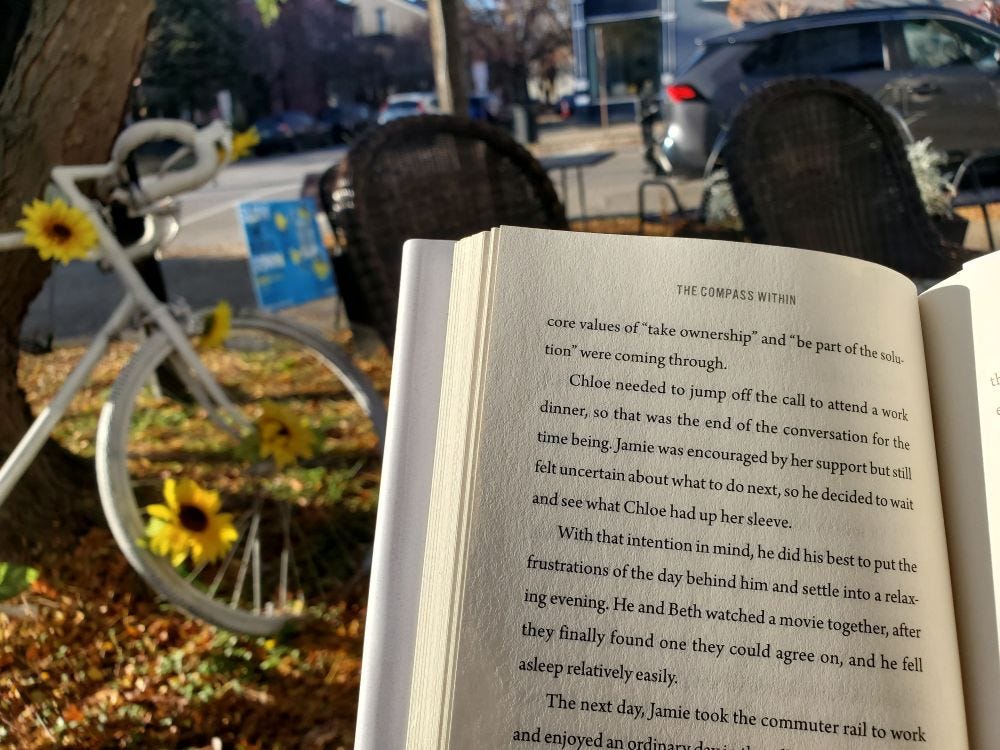
A few weeks ago, our office sent every single employee The Compass Within by Robert Glazer. Now I will confess: I am not a big fan of business/self-improvement books like this. (ie. The ones that are pint-sized and feel created to simply be marketing props to get on “Amazon Best Seller” lists or some other cheap ploy in that vein.) But our CEO, whom I do deeply respect, vouched for Compass and S is also currently traveling which means I had tons of free time last week, so I took a flier and actually read Glazer’s book.
To my complete shock, it was good! Like, actually, genuinely good.
Now, YMMV; it really all depends if you’re able to engage with the book sincerely and honestly. And I’ll admit: I don’t think I could’ve done this book a decade ago. As the saying goes, “the teacher appears when you are ready”, and I think I likely didn’t have the requisite self-knowledge or — more importantly, lived life experience — a decade ago to give this book a fair shake. (Not to mention, I think a decade ago, I was honestly just “unteachable”, for various reasons. 🙄)
But what was then. This past week I read the book and then actually did its pen and paper exercises. (Yes, it’s one of those kinds of books.) My results surprised me so I wanted to take a snapshot in time by dedicating this month’s dispatch to my findings.
My four core values, stack-ranked:
1. Curiosity
Phrase: “I love learning and am drawn to novelty.”
This is perhaps the most prime of my Prime Directives. I love learning. Reading, podcasts, TV shows, movies, talking with people. I love learning about most things, experiencing novel things, visiting new places, seeing new cultures, watching new kinds of movies. My life mottos are, “If you don’t try, you’ll never know.” and, “Try everything once before categorically rejecting things.”
Example of failure: I was judgmental about social media for many, many years and harbored extreme prejudice towards it despite never having really fairly tried it. Then on January 1, 2024, I committed to using social media every single day. It’s changed my life and I post at least once every day now. One of my genuine life regrets is that I did not use social media earlier. I believe had I done so, I would be living a totally different life right now.
Incuriosity is unthinkable to me. I possess a deep-seated desire to know and understand, “why?” “Because I said so.” is a deeply unsatisfying answer to me.
2. Community/sharing/pluralism
Phase: “We live in a society; a meaningful human existence requires others.”
Learning and living on your own is fantastic, and I did that for many decades solo, but after I met S nine years ago, I’ve slowly realized that human life — IMHO, at least — is most enriching and fulfilling in multiplayer mode. Life, is ultimately, short. I turn 40 next year and am essentially about halfway through life. If you’re not paying attention, you’ll literally just die one day without really knowing what happened. Spending time with people you love, care about, and admire has become deeply important to me. I do believe that “we are all connected by a red thread”. I believe in a very woo woo way that I am ultimately an instrument of the Universe. And only when my words and actions are public can I — in whatever small humble way, shape, or form that is required — touch another human being’s life in the way that the Universe wills. I believe we all have our parts to play and while I can’t prove it I do believe that there’s a greater, higher power at work and part of my responsibility as an entity that exists is to serve It.
Example of failure: When I was in my twenties I contributed a ton to my company’s SharePoint. Not just work stuff but also a personal corner of it I’d called, “Robertland”. (Lol, that SharePoint page may even still be alive to this day! 🤔) We didn’t have the vocabulary for it back then, but that closed space (it was internal to only the company) was what Yancey Strickler and Joshua Citarella would today call a “Dark Forest”. Anyway, after I’d left the bank, I completely lost access to their internal SharePoint, thereby vaporizing the countless hours of investment I’d spent on Robertland. 😭 It was a bitter lesson, but one I’d learned well; I now refuse to participate in any closed space which can be taken from me at a moment’s notice and am now an ardent POSSE acolyte.
A solitary life where I don’t share is unthinkable to me. (When people get too isolated they go the way of the Unabomber; it’s not good for them or society.) When I hear a cool podcast or YouTube clip, I am always thinking of which friend would value the clip. I love sharing because it’s also a way to stay connected to loved ones as well and also a way to leave archival exhaust; a trail of breadcrumbs of what caught my fancy at various points of my life.
3. Selective growth and continuous improvement in what I care about
Phrase: “If we’re not moving forward, we’re dying.”
A world where I’m not advancing in a way I consider meaningful or enriching is literally hell on earth to me. This week, it might be learning the (price-gouging) Adobe suite of tools and how to make comics with generative AI. Next week, it might be writing a short story to submit to a Science Fiction & Fantasy competition. Above nearly all else, I value my freedom and the ability to pursue projects that speak to my soul. When the Universe beckons, I feel obliged to honor Its call.
Example of failure: For my first job out of college, I’d worked in back office infrastructure technology at a bank. It paid handsomely but was ultimately stagnating in a way that adversely impacted my health. The job wasn’t even hard. It was simply, when I reflect upon it now, too narrow. I was a software developer back then and could go entire weeks without really speaking much to other human beings. It was not a good fit and I eventually developed health issues so severe that I needed to leave the company.
Stagnation is unthinkable. Not finding my work interesting is unthinkable. Does that make me spoiled? Yes. I concede this point because it costs me nothing, because it is true. I am spoiled. I’m not proud of my inability to tolerate stagnation but it’s the cards I’ve been dealt so I make lemonade. I think of it as a kind of disability; that is, the inability to repeatedly do things that I dislike in a manner that is not time-bound. It literally does not matter how much money I am given; I sadly cannot do something ad nauseam if I dislike it. ☹️ I have learned empirically that my own body will literally rather die than have my mind and soul stagnate. So I’ve done what I needed to do to survive.
4. Fairness + following rules
Phrase: “Rules apply uniformly to everyone and actions have consequences.”
I believe in doing everything possible to decrease the effect of random luck on outcomes. And, notably, when I think of an unfair world (for example, a more equitable world where certain populations are given advantages because of historical structural inequities, that positively grinds my gears. So for instance, I agree with the Supreme Court’s decision that affirmative action is unlawful), there is only one entity that’s allowed to make things unfair: The Universe. The Universe sets different starting lines for everyone and that is, I believe, Its intentional will. Again, I believe we all have our parts to play and as humans, we play the cards we are dealt; it is what it is. We need to follow the rules because, “We live in a society.” (See point 2.)
Example of success: S and I own a Tesla and give Elon money every month for our car insurance. The Tesla insurance program tracks every single vehicular movement. If we speed on the highway, we pay more the next month. If we don’t stop entirely at stop signs, it dings us for that too. It literally dings us for every possible violation in the book; every single driving infraction we make in a month monetarily penalizes us the next month. I deliberately have chosen to enroll us in Elon’s program because I think it’s the right thing to do. (As Sartre memorably remarked, “in choosing for himself he chooses for all men.”) Yes, I could be paying less in premiums each month to State Farm. But if we break the rules, we should suffer the consequences. And if I had my way, it would be like this for everyone. For example, one day I dream of a world with total interconnected ubiquitous surveillance where if you sped in a school zone, your license would simply be instantly automatically revoked. Think of all the lives such total blanket surveillance would save. (For the record, they’re already doing this with CCTV systems in the UK, Singapore, and China. America is simply behind, but I trust we can eventually catch up!) In summary, I believe in the greater good.
For the record, I take it even farther than automobile insurance and registration too. Example: back in college (twenty years ago, now!), my roommate and I used to play the Xbox game, Gears of War, at his house in Flushing and there was a ridiculous weapon called the Hammer of Dawn. It was an orbital, satellite-based laser system that you could call down from on high which would vaporize whatever you pointed it at in the game.
If I had my way, anyone who littered in public spaces or didn’t pick up after their dog would simply be smitten on the spot from the heavens, vaporized by a Hammer of Dawn-style orbital laser system. It doesn’t matter to me your marital/parental status, color, creed, age, LinkedIn title, socioeconomic status, or sex. I literally do not care if you are The President of the United States, Tom Cruise, or Taylor Swift. If you sully the commons, I would expect instant justice in a perfect world. This is one of my core values: fairness + rules following. Every time I see litter or dog poo outside in public I do feel a shock of anger. I believe that people who don’t follow rules warrant punishment for the benefit of broader society. If there are no consequences for bad actors, then what ties civilization together?
—
Anyway, I do really endorse and highly recommend Robert Glazer’s The Compass Within. For years now, I’ve had these thoughts all floating about in my mind in a nebulous constellation but never properly took the time to sit down and concretize my values in a formal way like this Substack post. I am super grateful that our company gave us all copies! Again, I know it may initially seem cringe, but I really do highly recommend sitting down and actually doing the exercises in the book. Glazer has a great passage from the book, which I’ll end on for this month (emphasis, mine):
“Your core values are not aspirational traits, nor are they marketing slogans aimed at presenting you in the best possible light. When identified correctly, they describe who you are and likely who you have always been. Therefore, articulating them is a process of discovery, not invention or self-optimization. You are looking for the instruction manual for your personal operating system… We all start life without an instruction manual or a compass, but this does not mean we have to continue navigating without one."
See everyone in December! One month left in 2025!! 🥳
Warmly,
Robert
—
Postscript - other stuff in November
Back in early November, Dan Hunter asked me to write 1,000 words on “How I leverage LLMs” for Indie Thinkers which I loved putting together! I believe that despite being epistemologically unsound, LLMs will continue to garner mass adoption and daily usage at unprecedented speed. I agree with Peter Thiel’s characterization of AI as “polytheistic”.
In November, the crew and I watched The Running Man - I liked it! Recommend. 👍
Postscript 2
Refinement - 12/3/25:
[Note: I’d originally specified “diversity” on 11/29; changed to “pluralism” on 12/3.]
One thing I really liked about reading Glazer’s book is that in subsequent days after finishing Compass and writing about it, I’ve continued thinking about it. Specifically, one of the chief constraints in Glazer’s framework that you’re limited to only four core values and so this necessarily forces you to think hard about the precise words/phrases you choose. One of my faults is I’m sometimes sloppy with words, especially words that occupy similar embedding space.
So after initially writing this document and publishing on 11/29, I’ve been continually pressure testing my values and reflecting on core memories (think of the little orb things in Pixar’s Inside Out movies - those are a fundamental component of Glazer’s framework too; our core values are often informed/influenced by our core memories).
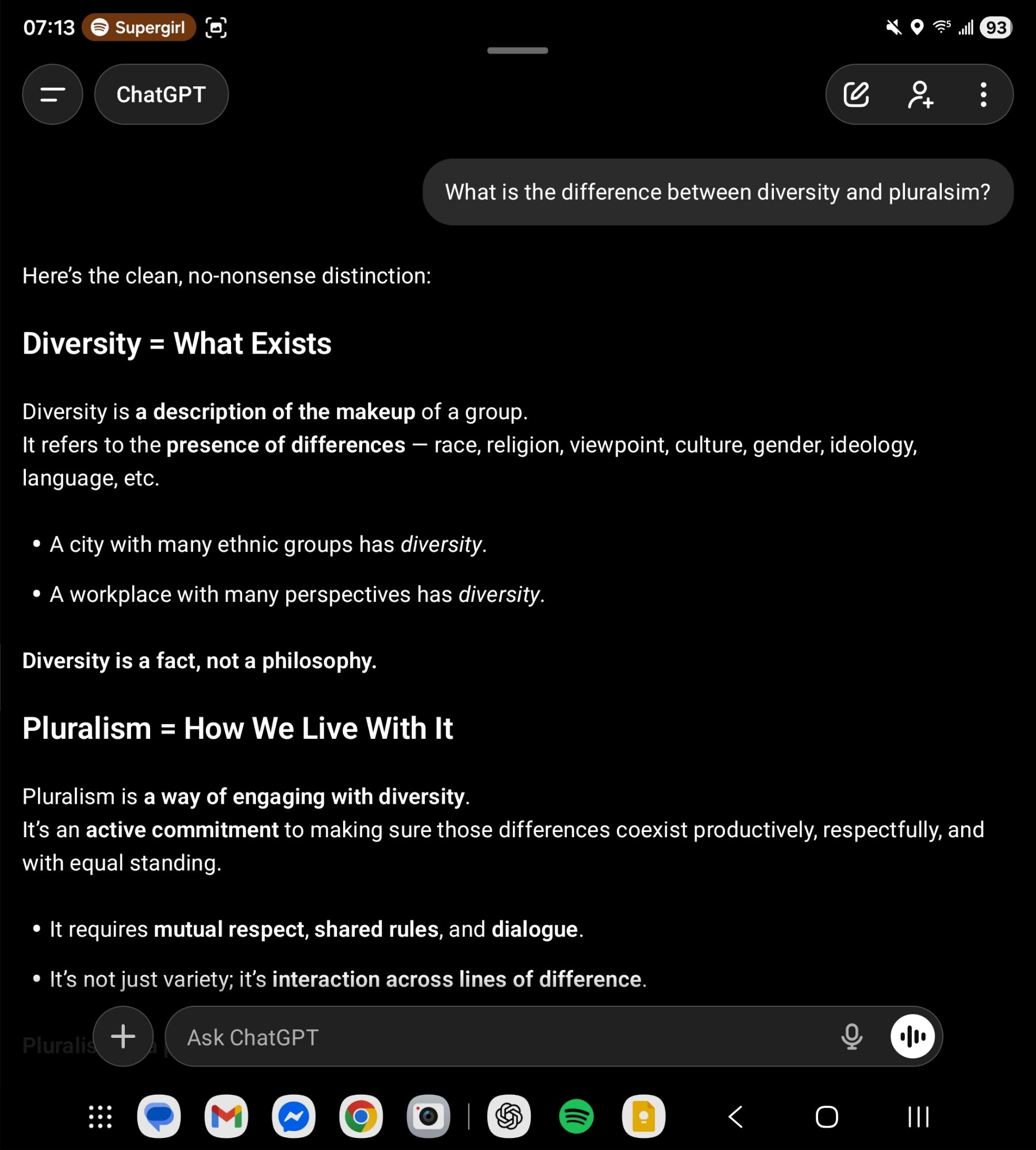
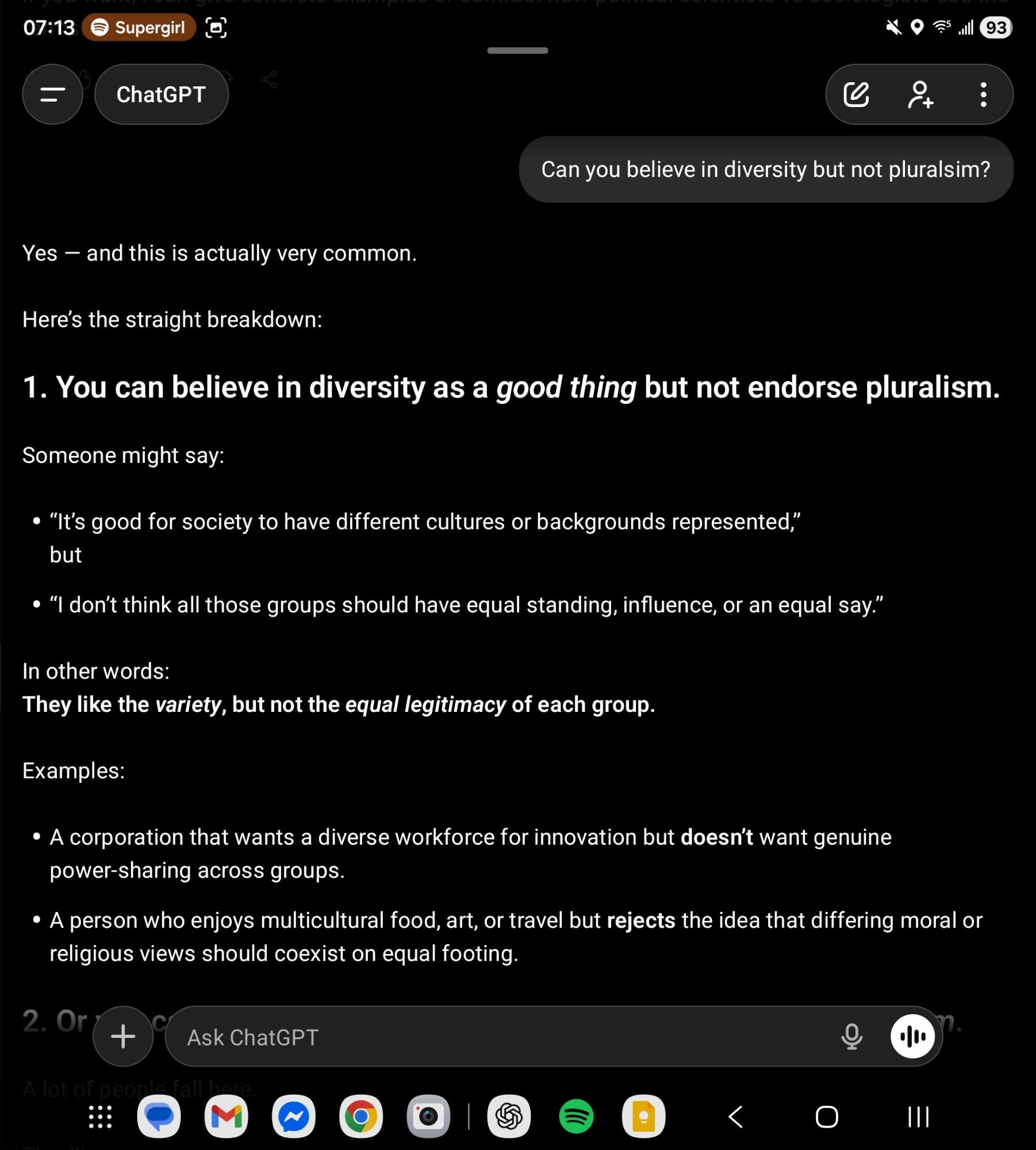
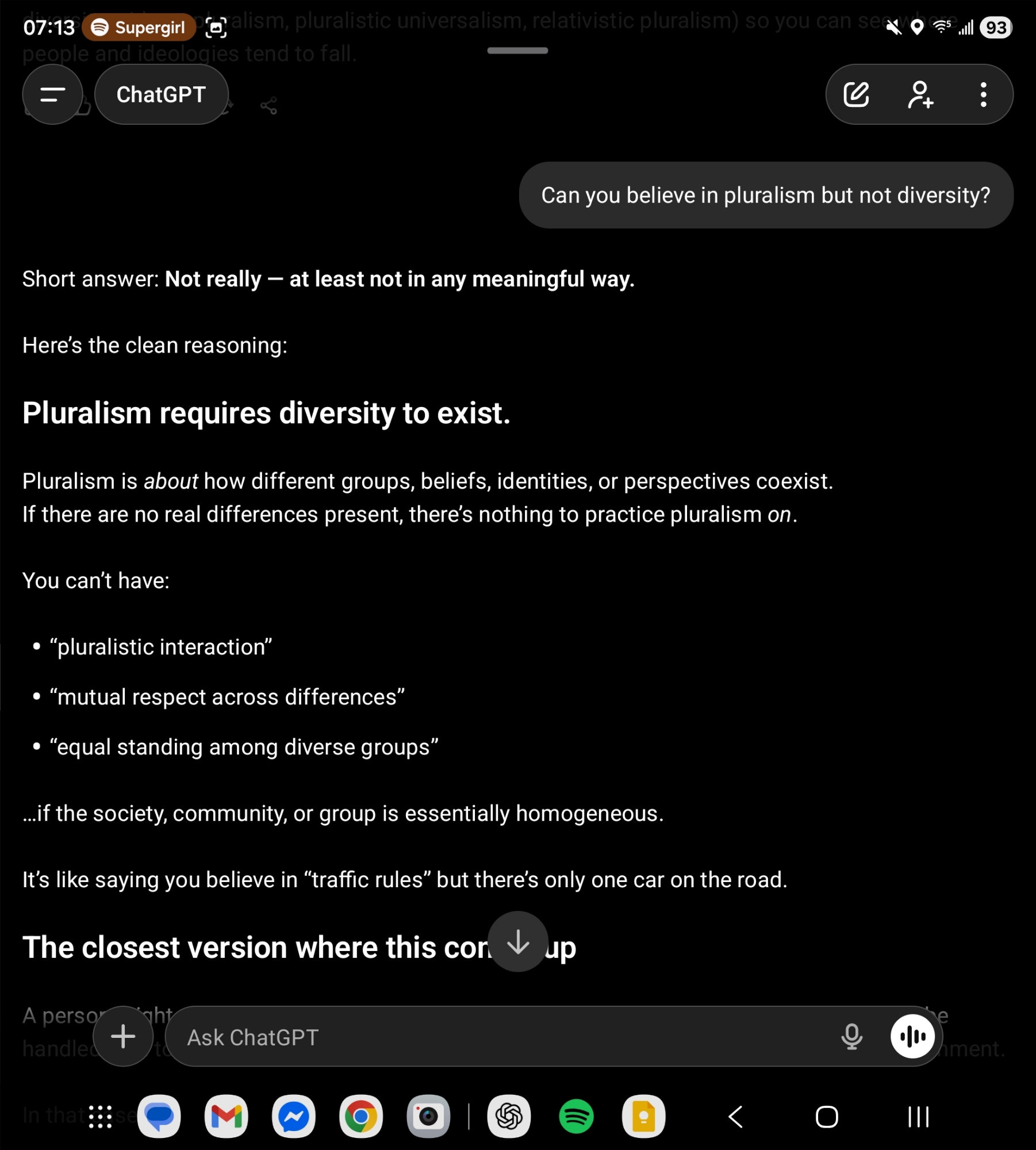
After thinking harder about it, I’ve revised my core value #2 of “diversity” to “pluralism”. (In particular, I want to credit ChatGPT which (IMHO) is the best personal Socrates that $20/mo can buy and helped sharpen my thinking/understanding here.) “Diversity” is a descriptor. “Pluralism”, OTOH, is a way of life. It’s possible to believe in diversity but not in pluralism. However, it’s not possible to believe in pluralism but not diversity. After reflecting, I realized that, for me, diversity is necessary but not sufficient. I believe in more than diversity - I believe in engaging with the commons, sharing, and understanding others, especially if we disagree. As ChatGPT puts it: believing in pluralism is believing in “interaction across lines of difference”. Pluralism is one of my core values.
Love this Robert. Out of curiosity, what company was it that gave it to you?
I Love reading this. I too did all exercises.